Reflecting on 25 years of IVI with Dr. Richard Mahoney
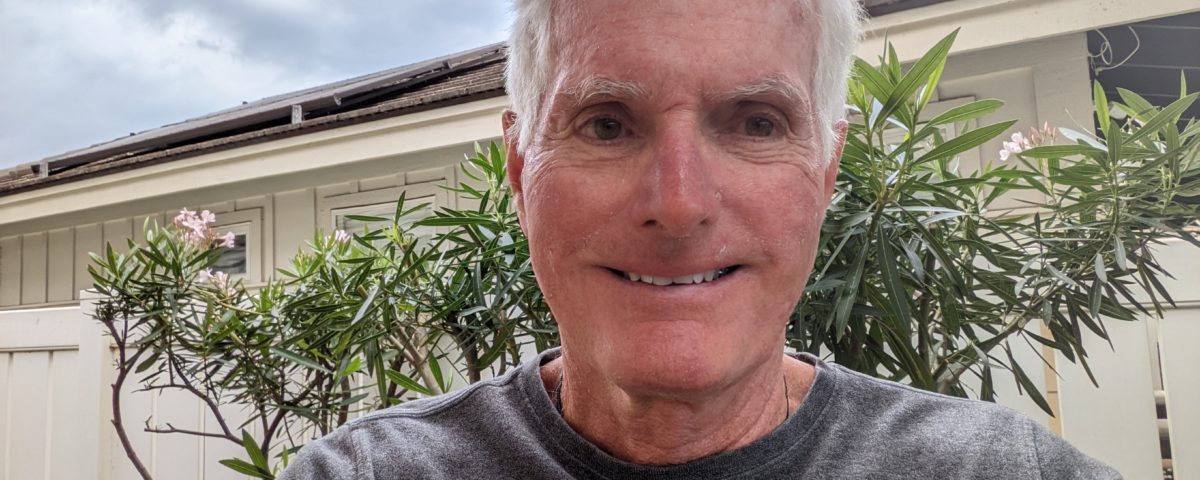
Dr. Richard Mahoney, who first helped lead the formation of the Children’s Vaccine Initiative and later the establishment of IVI, was on the ground since Day 1 to set up the fledgling international organization and articulate its vision.
We had the pleasure of catching up with Dr. Mahoney to capture the early days of IVI in commemoration of our 25th anniversary.
Can you describe the journey to the formation of IVI?
In the early 1990s, UNDP, UNICEF, WHO, World Bank and the Rockefeller Foundation founded the Children’s Vaccine Initiative (CVI) to advance efforts in developing extraordinarily innovative new vaccines, e.g., a single shot for all diseases. The CVI asked various organizations concerned with vaccines, including USAID, to second staff to help set up the CVI. At the time, I was with PATH and had just helped to launch the International Task Force on Hepatitis B Immunization which was making important headway. USAID was a funder of PATH, and it asked PATH to second me to the CVI Secretariat where I was appointed Secretary of the Task Force on Strategic Planning, which was the lead Task Force among many for the establishment of the CVI.
As Secretary, I worked directly with all the other Task Forces and founding agencies. Dr. Seung-il Shin, with whom I had worked on hepatitis B, called me with his idea of establishing a vaccine research institute in Asia. I strongly supported Dr. Shin’s appointment to UNDP to and Shin ended up being appointed to the staff of the UNDP to lead a feasibility study for the proposed institute. I closely observed his work and provided advice where I could. When Korea won the competition as the home of the institute, now formally named the International Vaccine Institute, I offered to help in its establishment in Korea. Since the IVI was not yet a legal entity, I was appointed to the staff of the UNDP and posted to Korea.
And what was your role in establishing the institute?
I arrived in Korea in January 1995 to biting cold of about -15 degrees centigrade to join a team of Shin and Dr. Gurinder Shahi. With my experience of helping to found and establish PATH as a successful international organization, I took the lead on setting up IVI as a functioning organization. I authored the Constitution and all the written policies including those for the Board of Trustees, Personnel, Finance, Intellectual Property Management and others. In collaboration with staff of the Korean Ministry of Foreign Affairs and Frank Hartvelt of the UNDP, I helped the effort to obtain signatures for the Establishment Agreement. After IVI was formally established in November 1997, I took on the responsibility to oversee all administrative functions. I was appointed Secretary to the Board and managed its operations under the brilliant leadership of the first Board Chair, Prof. Barry Bloom.
What was the founding vision for IVI in 1997 and what gap did the institute seek to fill in the global health space?
The vision of the IVI was enunciated in its first Strategic Plan of 1998. I was the lead author of the plan which was prepared with guidance from an outside set of advisors led by Dr. Suryanarayan Ramachandran of India, who had been the founding Secretary of the Indian Department of Science and Technology, and included Dr. Demissie Habte of Ethiopia, who had been the Director General of the Institute for Diarrheal Disease Research, Bangladesh. The development of the plan also received inputs from a wide spectrum of individuals and organizations.
- The International Vaccine Institute is founded on the belief that health in developing countries can be dramatically improved by the development, introduction and use of new and improved vaccines and that these vaccines should be developed through a dynamic interaction among science, public health, and business. The International Vaccine Institute will be a center of science for the public interest where this dynamic interaction can take place through research, training, technical assistance, service provision, and information dissemination.
The Strategic Plan also laid out the comparative advantages:
- A health research institute with a unique structure and focus
The Institute is the world’s only International Organization formed under the Vienna Convention devoted to research on vaccines of priority for developing countries. It joins the family of other international organizations, the most prominent research members of which are the international agricultural research centers. It will enjoy certain privileges and immunities similar to those granted a United Nations organization. The Institute is governed by an independent Board of Trustees, a majority of which is elected in their personal capacity. Its staff will be recruited on the basis of technical merit and drawn from all countries. The Institute can be a flexible and focused center of excellence.
- In the public interest
Infectious diseases affect all people, but they have the greatest impact on the poor in developing countries. Every person needs vaccines, but for the poor it is especially important that the vaccines be affordable. Vaccine research and development demands effective collaboration with the private sector. As a not-for-profit organization, the Institute can engage in collaboration with the private sector. Because the Institute accords highest priority to serving the public interest, it will eagerly assume, in collaborative relationships, a significant portion of the risk associated with the development of vaccines that may not have the level of commercial promise required by private sector companies.
- A global perspective from Asia
Asia has been moving through a major social, economic and technologic revolution. The region comprises over half of the world’s population. Several diseases, such as Japanese encephalitis, appear more frequently in this region than in other parts of the world. Throughout Asia, there are many emerging research centers and several excellent vaccine production sites. There is a rapid growth in demand for new and improved vaccines in Asia with hepatitis B being the most prominent example. The IVI will seek to form bridges among itself and organizations in Asia and elsewhere. Thus, the IVI can help take advantage of the great opportunity to employ Asian resources for the benefit of all.
Reading these words 25 years later, I believe they are still accurate.
What led you to focus on dengue vaccine development and how was the Pediatric Dengue Vaccine Initiative formed?
In its early days, PATH received funding from the Rockefeller Foundation whose health staff included Dr. Scott Halstead. PATH’s seed grant for hepatitis B work was $50,000 from the Foundation. Halstead and I got to know each other well. In the late 1990s, when Halstead got a nod from the Gates Foundation to prepare a proposal for funding a dengue program, he asked me to help because he thought I knew how to form effective public-private partnerships. Halstead had set up a Board of Councilors that did not have a connection to a legal entity that could receive grants. I proposed that the dengue program be based at IVI. Following extensive discussions between Halstead and Dr. John Clemens, the first Director General of IVI, it was agreed that the dengue program would be located within the IVI. A successful proposal for $53 million was subsequently submitted.
I had left IVI in 2002 and was a professor at Arizona State University and the Senior Advisor in Health to The Rockefeller Foundation. I found the dengue program most interesting and, in 2004, asked if I could join. I spent the next nine years working on dengue for IVI.
Do you have any memorable anecdotes from the early years of IVI to share?
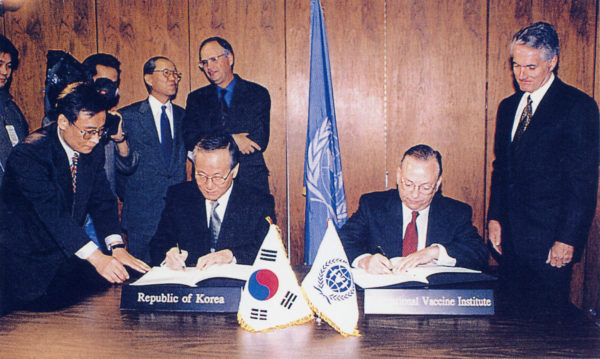
To be frank, the early years of IVI were extraordinarily difficult. One of the biggest challenges was to provide a clear and believable vision for the Institute so that it would be easier for others, including some of our closest associates, to give their full support. As Professor Cho often said, “Building the IVI is like crossing a mountain range. As soon as you reach one mountain top, you see many more in front of you.” So, one of my favorite memories is standing next to Barry Bloom at UN Headquarters in New York when he signed the Establishment Agreement that made the IVI a legal entity as an International Organization. I felt that, along with dozens of colleagues and friends, I had successfully climbed not the last mountain, but enough mountains to see that the IVI would live and prosper.
What do you consider one of IVI’s most significant contributions to global health and what do you hope IVI accomplishes in the next 25 years?
I think that the most significant contribution of the IVI is its very existence. It is a statement to the world that, perhaps above all other biomedical interventions, vaccines are necessary and invaluable for achieving global health.