- Agree to expand collaboration in vaccine development & delivery, training
- Exchange additional letter of intent on cooperation in epidemiology training
IVI, KDCA exchange MOU on ROK’s state funding, strengthened cooperation
IVI, KDCA exchange MOU on ROK’s state funding, strengthened cooperation
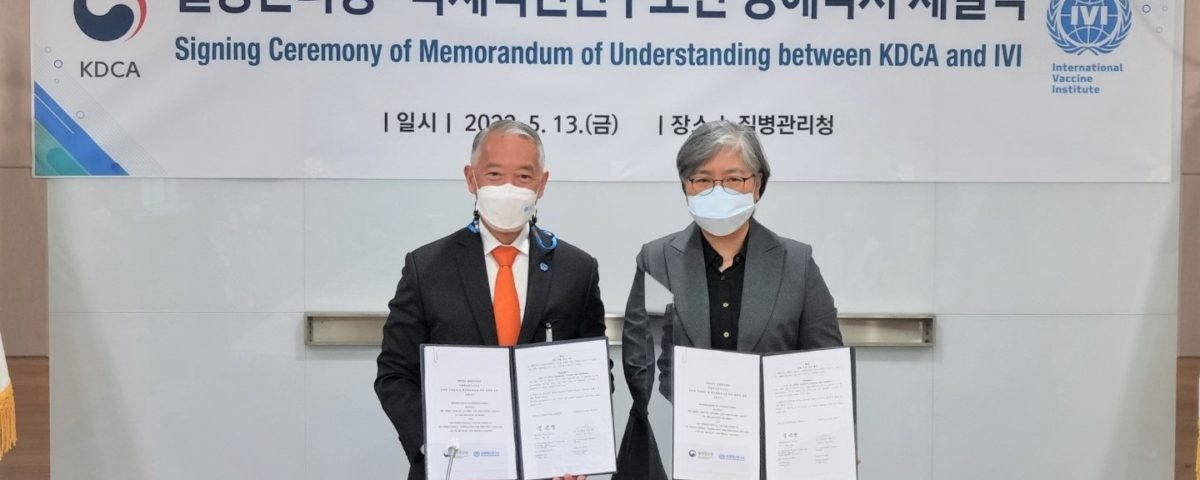
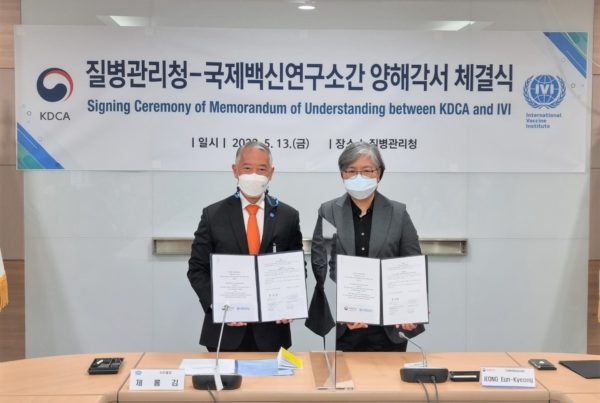
May 13, 2022, SEOUL, Korea — The International Vaccine Institute (IVI) and the Disease Control and Prevention Agency (KDCA), Republic of Korea, exchanged a memorandum of understanding (MOU) that aims to facilitate KDCA’s core contribution to IVI on behalf of the Government of Korea and expand bilateral cooperation.
The MOU was exchanged at a signing ceremony at KDCA headquarters in Osong, Korea on May 13. In attendance at the ceremony were Commissioner Dr. Eun-kyung Jeong, Dr. Dong Gyo Yang, Director General for Planning and Coordination, Dr. Sang Won Lee, Director General for Public Health Emergency Preparedness, Dr. Sung Soon Kim, Head of the Center for Vaccine Research and other senior officials from KDCA, as well as Director General Dr. Jerome Kim, Deputy Director General of Government & Public Relations Dr. Kyung Taik Han, and Deputy Director General of Science Dr. Manki Song from IVI.
With the new MOU, KDCA renewed its commitment to provide annual core funding contribution to IVI on behalf of ROK. KDCA and IVI agreed to cooperate in operation and research activities to help IVI achieve its goal of protecting people in developing countries from infectious diseases through development and delivery of vaccines and application of technologies for global health. KDCA also agreed to actively support joint research projects and training programs between IVI and Korean industry, academia, and research institutes, part of joint efforts to accelerate the globalization of Korean vaccines and help Korea increase contributions to global health.
At the ceremony, the two sides also exchanged a separate letter of intent on cooperation in the “EPIC (Epidemiology, Public Health, Impact) Fellowship program.” Funded by KDCA, the program will promote expertise of Korean professionals by training and engaging them with field operations in epidemiology and public health in Africa and Asia coordinated by IVI by leveraging IVI’s experience, capabilities and global network.
IVI and ROK have had robust, mutually synergizing relationship ever since IVI’s establishment as the first international organization hosted by Korea in 1997. As the government body overseeing IVI affairs, KDCA has extended generous support and active cooperation with IVI over the past five years. In the wake of the pandemic, IVI and KDCA and its National Institute of Health have been closely collaborating to accelerate the development of vaccines, with IVI supporting the establishment of the Korea standard and reference panel for anti-SARS-CoV-2 antibody. IVI and KNIH also joined forces in testing of vaccines and recently completed analysis of clinical samples of SK bioscience’s COVID-19 vaccine candidate, which is currently under regulatory review process for licensure.
KDCA Commissioner Dr. Jeong said, “Experiencing the COVID-19 crisis, the international community has realized that various strategies such as crisis response, epidemiological investigation, and vaccine distribution are important to the world to be prepared for a public health crisis. In collaboration with IVI, we will try our best to prepare for a future pandemic.”
“With the generous support from KDCA, IVI was able to play a major role in responding to global public health crises by discovering and developing vaccines. With today’s MOU signing, I hope that KDCA and IVI will carry out various cooperative projects to prepare for and respond to threats to global health security, including vaccines.”
###
About the International Vaccine Institute
The International Vaccine Institute (IVI) is a nonprofit inter-governmental organization established in 1997 at the initiative of the United Nations Development Programme (UNDP). Headquartered in Seoul, South Korea, IVI was the first international organization hosted by Korea. IVI has 39 countries and the World Health Organization (WHO) on its treaty, including Korea, Sweden, India, and Finland as state funders.
Our mandate is to make vaccines available and accessible for the world’s most vulnerable people. We focus on infectious diseases of global health importance such as cholera, typhoid, shigella, salmonella, schistosomiasis, Group A Strep, Hepatitis A, HPV, TB, HIV, MERS, COVID-19, as well as antimicrobial resistance. For more information, please visit https://www.ivi.int