IVI and the People’s Republic of China
Member State Relations
On 13 January 1997, China signed the IVI Establishment Agreement.
On 18 August 1997, China deposited an instrument of approval to the IVI Establishment Agreement.
On 25 August 2020, the Embassy of China to the Republic of Korea donated $20,000 USD to IVI for vaccine research and development as well as efforts to advance international cooperation for vaccines against infectious diseases including COVID-19. H.E. Xing Haiming, the Ambassador of China to the Republic of Korea, visited IVI’s Headquarters to deliver the donation and meet with IVI Director General Jerome Kim.
Chinese Leadership at IVI
Prof. Chen Chunming (陈春明), Chinese Academy of Preventative Medicine, 1995-2000
Prof. Wang Ke An, Chinese Academy of Preventative Medicine, 2001-2003
Prof. Dr. Zhuang Hui (庄辉), Peking University Health Science Center, 2004-2007
Prof. Bin Wang (王斌), School of Basic Medical Sciences, Fudan University, 2018-2020
IVI: Award Winning Research in China
In 2001, IVI’s then lead scientist Dr. Xu Zhi Yi received China’s National Science and Technology Award (J-233-2-11) for his work on the Hepatitis A vaccine.
Ongoing Collaboration
Expanding COVID-19 Vaccine Access and Delivery in Africa (ECOVA) 1 & 2
Beginning in July 2021, ECOVA-01 is a Phase 3 randomized, observer-blind, controlled trial to assess the efficacy, immunogenicity, and safety of Sinopharm’s BBIBP-CorV vaccine against SARS-CoV-2 infection.
IVI and Mozambique’s Instituto National de Saúde (INS) are conducting a Phase II mix-and-match trial in Mozambique to investigate a heterologous prime-boost regimen using Sinopharm’s BBIBP-CorV and Johnson & Johnson’s Ad26.COV2.S vaccines compared to prime-boost regimens using the same product for homologous prime and boost.
The ECOVA team conducted a COVID-19 vaccination campaign in Beira with the Sinopharm vaccine where 55,051 people were vaccinated with the first dose and 43,681 with the second dose in a Phase II mix-and-match trial of two COVID-19 vaccines from Sinopharm and Johnson & Johnson.
The project aims to demonstrate the safety and efficacy of a mixed schedule of COVID-19 vaccines, which may have a significant impact on ensuring timely vaccinations and controlling the pandemic in regions most affected by vaccine shortages.
ECOVA 01 and 02 are conducted in cooperation with Mozambique’s Instituto Nacional de Saúde (INS) and made possible by a $12.7 million USD grant from the Coalition for Epidemic Preparedness Innovations (CEPI).
Hepatitis E vaccine Phase IIb in South Africa
In 2023, IVI launched a project to evaluate the immunogenicity and safety of Hecolin® in HIV positive/negative adults and children from two to 45 years and to demonstrate the immune non-inferiority of two-dose versus three-dose regimens in younger age groups. This study will generate the evidence needed for inclusion of children within vaccine use policy recommendations and for informing policy on vaccine administration to people living with HIV/AIDS at risk for HEV infection.
By investigating the efficacy of abbreviated dosing regimens aimed at reducing vaccine costs and logistical complexity, the findings of this study could contribute to promoting the co-administration of HEV and HPV vaccines, providing a pathway for the routine introduction of the HEV vaccine in endemic countries. Subject enrollment for the study is set to begin in early 2024.
Safety and immunogenicity of Hecolin® (HEV Vaccine) in pregnant women
In 2022, IVI launched several projects to generate necessary epidemiologic and clinical data to advance the use of Hecolin®, a highly efficacious HEV vaccine registered for domestic use in China and Pakistan, in global endemic settings. As a result of this work, several grants were awarded in 2023 to conduct clinical trials and generate disease burden data to fill evidence gaps.
Additionally, IVI and collaborators received funding from the Bill & Melinda Gates Foundation, Open Philanthropy, and Thrasher Research Fund to conduct a Phase II clinical trial of Hecolin® in Pakistan. This trial will evaluate the safety and immunogenicity of the vaccine in both pregnant and non-pregnant women. Under the supervision of Aga Khan University, over 2,300 participants will be enrolled in Karachi across four sites which previously hosted the Alliance for Maternal and Newborn Health Improvement biobanking study participated by investigators researching maternal and newborn health interventions in South Asia and sub-Saharan Africa, as well as the WHO.
By demonstrating the safety and immunogenicity of Hecolin® in pregnant women, IVI and its partners aim to facilitate use of the vaccine in pregnant women at highest risk for severe disease and advance WHO prequalification and potential recommendation by the Strategic Advisory Group of Experts on Immunization (SAGE) for this critically needed vaccine.
Impact of vaccination using the Clover SCB-2019 COVID-19 vaccine on household transmission of SARS-CoV-2 infection
The main objective of this study is to assess whether there is a reduction in COVID-19 infections in the households of clinical trial participants who received the Clover SCB-2019 COVID-19 vaccine compared to those who received placebo. The study outcomes, focusing on the occurrence of confirmed COVID-19 infections among households and household contacts of SPECTRA placebo or SCB-2019-infected recipients, were published in Clinical Infectious Diseases in April 2023.
The findings revealed a trend indicating a potential reduction in the risk of secondary SARS-CoV-2 infections in contacts of vaccinated index cases compared to their unvaccinated counterparts.
Concurrently, the team successfully concluded a sub-study employing dried blood spots for the quantitative detection of anti-SARS-CoV-2 IgG antibodies through ELISA. The results demonstrated that, in comparison with sera, the DBS method exhibited 100% sensitivity, 99% specificity, a 99% positive predictive value, and 100% negative predictive value. The manuscript detailing this sub-study was submitted to the American Journal of Tropical Medicine and Hygiene in July 2023. This innovative approach using dried blood spots may prove valuable in SARS-CoV-2 household or population serosurveys in contexts with limited sample collection, shipment, and storage.
Previous Collaboration
Hepatitis E Vaccine Roadmap
In collaboration with Johns Hopkins University and Syracuse University, IVI is contributing to the development of a roadmap to identify the key remaining barriers to wider available and use of the HEV vaccine Hecolin® produced by China’s Innovax Biotech. As part of this project, IVI will identify and prioritize clinical evidence gaps to inform policy and meet requirements (SAGE, WHO, and country-level) for routine and emergency use, while also assessing the readiness of Hecolin® for WHO prequalification and the status of other manufacturers with HEV vaccines in their development pipelines. Work began in mid-2021 with the first meeting of the Policy Advisory Group and Technical Advisory Group.
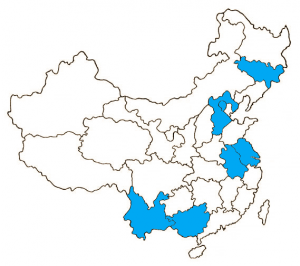
IVI: Action across China

Anhui Province
- 2001-2003 rotavirus/diarrhea study
Beijing
- 1999 Hib/meningitis study
- 2001-2003 rotavirus/diarrhea study
Guangxi Province
- 2000-2007 DOMI program typhoid research and vaccination trial
- 1998-2002 Hib/meningitis incidence study
- Cohosted the 2015 International Symposium on Typhoid in Guilin
Hebei Province
- 2001-2003 rotavirus/diarrhea study
- 2003 Shigella/dysentery disease burden and cost of illness studies
Jiangsu, Jilin, and Yunnan Provinces
- 2001-2003 rotavirus/diarrhea studies
Shanghai
- 2002 public health impact and cost-effectiveness studies on the Japanese Encephalitis vaccine
Zhejiang Province
- 1998 vaccine production workshop at Zhejiang Academy of Medical Sciences
Childhood Empyema and Pneumonia
From 2005 to 2008, IVI began a study on childhood empyema in the Asia-Pacific, which was followed by a surveillance study conducted in Australia, Korea, Taiwan island, and Thailand.
IVI’s childhood empyema surveillance study continued to examine hospital and lab records of children over 15 years of age at representative hospitals in 2007, pulling records from four representative hospitals in mainland China, Korea, Taiwan island, and Vietnam. The study was conducted to identify gaps in knowledge about childhood diseases that could prospectively be treated by pneumococcal conjugate vaccines.
In 2008, IVI utilized funding from Wyeth Vaccines to collaborate with local doctors on Taiwan island to study the burden of childhood and adult hospitalizations in the Asia-Pacific due to pneumonia.
Dengue Research
In August 2007, the 3rd Asian Dengue Research Network, co-sponsored by IVI and the Novartis Institute for Tropical Diseases was held in Taipei, Taiwan. The event was attended by over 400 researchers from the Asia-Pacific.